
What Does “Consignment” Mean When You’re Selling a Car?
I put off selling my old sedan for eight months. Eight. The thing sat in the driveway collecting pollen while I invented reasons not to deal with it. Listing it online felt like a part-time job I never applied for. And the dealership's trade-in quote? I laughed out loud — not the good kind of laugh.
Then a friend mentioned she'd "put hers on consignment." I nodded like I knew what that meant. I didn't.
So if you're sitting where I was — a car to sell and zero desire to babysit the whole circus — here's the plain version, no jargon.
The short version
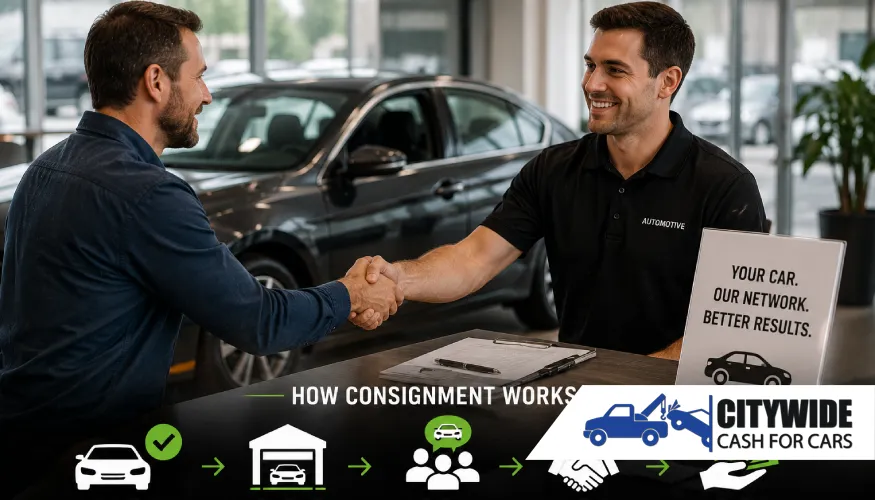
Consignment means you let a dealer sell your car for you, and they take a cut when it sells.
That's the whole idea. You drop it off, they do the work. And here's the part that surprises people: you still own the car the entire time. They're not buying it from you. They're selling it on your behalf — think of a real estate agent listing a house they don't own.
So what happens after you hand over the keys?
Roughly this.
You sit down with the dealer and agree on two numbers: the price you want, and the fee they'll take. Get both in writing. (The fine print matters — I'll come back to that.)
Then they take over. They'll clean it up, shoot the kind of photos you'd never bother taking yourself, and list it everywhere — their site, the big marketplaces, the lot out front where weekend browsers wander through.
After that, your phone goes quiet. They handle the "is this still available?" pings. They screen out the flakes. They ride along on test drives so a stranger isn't sitting alone in your car with your keys. And when a buyer's ready, they take care of the title, the paperwork, and the payment — all the stuff that gives private sellers heartburn.
Deal closes, they pull their fee off the top, you get the rest. Most days you won't set foot in the place again until it's time to grab a check.
The question everybody asks: what's it cost?
Fair. This is where consignment earns its skeptics.
Dealers charge one of two ways. Some take a flat fee — a fixed amount whether the car sells high or low, often somewhere in the few-hundred to roughly a thousand-dollar range depending on the shop and the vehicle. Others take a percentage of the sale price, and that slice can run anywhere from about 10% up to 20%, sometimes on a sliding scale that shrinks as the price climbs.
A few will slip in extra charges for detailing or reconditioning, so ask straight out: "What comes out of my end, and when do I get paid?" A clear answer is a good sign. A vague, hand-wavy one? Walk.
But here's the math that changed my mind. A dealer who knows how to price and stage a car can usually sell it for noticeably more than you'd wrangle on your own. Sometimes enough that, even after the fee, you land about even with a private sale — minus every ounce of the hassle. Do the numbers for your car, though. Don't take my word for it.
How it stacks up against your other choices
Three roads. Each one costs you something different.
Trade-in is the fast lane. Car's gone by dinner. You also walk away with the least money, because the dealer pays wholesale and then flips it at retail — that gap is their lunch.
Selling it yourself tends to pay the most. No middleman, no cut. But be real with yourself about the trade-off: now you're the photographer, the copywriter, the appointment-setter, and the person standing in a gas-station parking lot counting twenties. Some folks are fine with that. A lot of us are the "eight months in the driveway" type.
Consignment lives in the middle. Close-ish to private-sale money, none of the babysitting. What you're really buying back is your Saturdays.
Why people go this route
Convenience, mostly. But it runs deeper than that.
There's the safety piece — nobody's coming to your house, nobody's handing you a stack of cash you have to squint at. There's the skill; these people negotiate for a living and don't flinch when a lowballer starts working them. And there's the plain relief of making it somebody else's problem. Got a pricier or slightly unusual car? That professional polish can be the difference between limp offers and a real one.
The stuff nobody prints in the brochure
Consignment isn't magic, and it definitely isn't free.
The fee bites hardest on cheap cars. Selling a $3,000 runabout? Handing over a chunk of that stings, and you're probably better off listing it yourself. You also give up the wheel — you're trusting someone else's read on which offers to take, and their patience may not match yours. And it can drag. Weeks, sometimes. If rent's due Friday and you need cash now, wrong tool.
So read the contract. Yes, it's dull. Do it anyway. Find out who insures the car while it sits on their lot, what happens if it never sells, whether there's a time limit, and exactly how the payout works. Anyone worth trusting will walk you through all of it without getting squirmy.
Alright — is it right for you?
Depends entirely on you.
Gut check: precious weekends, strangers make you uneasy, and a car worth enough to justify the fee? Consignment's likely your move. Time to spare, a cheap car, and you kind of enjoy the sport of haggling? Sell it yourself and keep the difference.
Me, I handed my sedan to a consignment lot, drove home in twenty minutes, and got a call three weeks later saying it sold. The fee was real. So was never once having to think about it. For the way my brain works, that was worth every dollar.
And now you know what the word means — which is a lot more than I could've told you eight months ago.
