
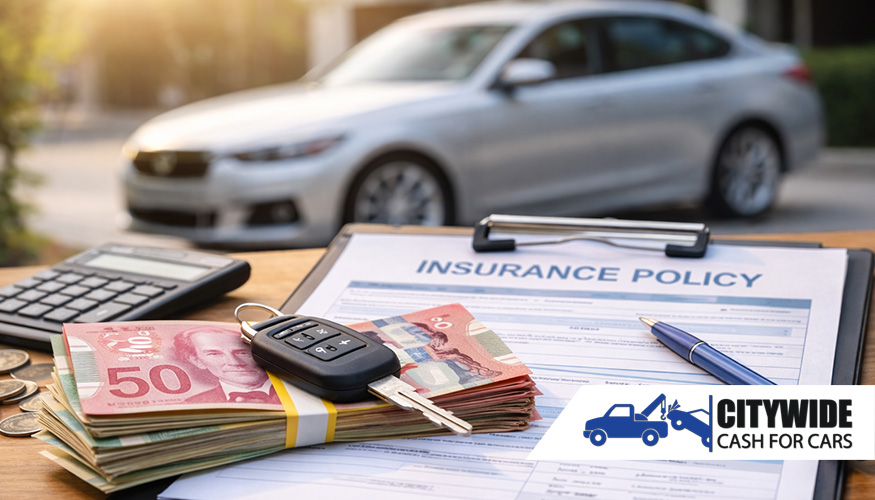
Stop Paying Insurance on a Car You Don’t Drive — Sell It Instead
Let me ask you something honestly. Is there a vehicle sitting on your property right now that you haven't driven in weeks — or maybe months? One that needs a repair you keep putting off, or got written off after an accident and just never got dealt with?
If the answer is yes, there's a reasonable chance you're still paying insurance on it.
Most people are. Not because they're careless with money, but because cancelling insurance on a parked car isn't exactly the first thing on anyone's to-do list. Life gets busy. The car sits. The automatic payment keeps going out. And before you know it, you've quietly spent over a thousand dollars insuring something that hasn't taken you anywhere in six months.
That's the problem this article is here to solve.
The Monthly Bill That Gives You Nothing Back
Car insurance in Alberta isn't cheap at the best of times. Depending on your coverage and driving record, you're likely paying somewhere between $150 and $280 a month on an older vehicle. For a lot of Red Deer households, it's closer to $200.
Now do that math on a car that doesn't run.
Six months of inactivity means somewhere between $900 and $1,680 already gone — and that figure keeps growing every single month you don't act. What's genuinely frustrating is how invisible this cost feels. The payment clears automatically. You don't swipe a card, you don't feel it, and so it doesn't register the way a big one-time expense would. That's exactly how it keeps happening.
And the insurance bill isn't even the whole story. A vehicle that just sits causes problems you probably haven't thought about:
- Rust doesn't wait for a convenient time to spread — it starts working the moment moisture finds bare metal, and an unused car gives it plenty of opportunity
- Tires left flat for months develop permanent flat spots and often can't be properly reinflated, meaning they'll need replacing even if everything else is fine
- Batteries in unused vehicles drain completely within weeks, and repeated deep discharge shortens their lifespan significantly
- In parts of Red Deer, leaving an inoperable vehicle on a residential property for an extended period can draw bylaw complaints — something most owners only find out about after it becomes a problem
Every one of those issues chips away at whatever value the car still holds. The clock is working against you here, not for you.
Here's Why You Can't Just Cancel the Insurance
A lot of people hear this and think: fine, I'll just cancel the policy. Easy fix.
It's not quite that simple in Alberta, unfortunately.
Provincial regulations require that any vehicle still registered in your name carries valid insurance coverage. This applies even if the car is parked and you have zero intention of driving it. If the registration hasn't been formally surrendered and you move the vehicle even once — backing it out to sweep the driveway, shifting it for a neighbour, anything — you're driving uninsured. Under the Alberta Traffic Safety Act, that means:
- Significant fines that escalate quickly for repeat offences
- Potential suspension of your driver's licence
- No coverage whatsoever if something goes wrong during that uninsured moment
So the options that actually work are either formally surrendering the registration through Alberta Transportation, or selling the vehicle and getting it out of your name entirely. And between those two choices, only one of them leaves you with cash in hand.
What That Old Car Is Actually Worth
Here's the part that surprises most people: a non-running vehicle still has real, tangible value. Not sentimental value — actual market value. The assumption that a car with no working engine is worthless is one of the main reasons people leave money sitting in their driveways for years longer than necessary.
Cash-for-cars buyers don't look at a vehicle the way a private buyer does. They're not thinking about whether they want to drive it. They're thinking about what can be recovered from it, and that list is longer than most people expect:
- Catalytic converters, which contain platinum-group metals and hold significant scrap value on their own
- Functioning mechanical components — alternators, starters, transmissions — that get refurbished and resold as used parts
- Body panels, glass, and interior parts that are in demand for repairs on the same make and model
- Raw scrap metal, which is priced by weight and holds value regardless of the vehicle's condition
None of that value disappears because the engine is blown or the frame is bent. A buyer who knows what they're doing can look at what most people see as a worthless wreck and come up with a fair cash figure in minutes.
What Actually Happens When You Call a Cash-for-Cars Buyer
No dealership. No listing on Kijiji. No strangers showing up to low-ball you after a test drive. The process is genuinely straightforward:
- You describe the vehicle — year, make, model, general condition. Most buyers in Red Deer handle this by phone or a quick online form. You don't need to send photos or prepare anything.
- You get a real offer — not an estimate, not a "depends on condition when we see it." A straight number, given to you upfront.
- They come to you — free towing is standard. The truck shows up at your property, they load the vehicle, and it's gone.
- You get paid on the spot — cash or e-transfer at pickup. Not later that week. Right there.
From the first call to the moment the car leaves your driveway, you're usually looking at 24 to 48 hours. Some buyers in Red Deer can do it same-day if you call in the morning.
A Real Example Worth Reading
Here's a situation that plays out more often than you'd think.
Someone's got a 2013 sedan that took front-end damage in a parking lot collision. Insurance assessed it as a write-off. The repair quote from the body shop was $4,900. The car's pre-accident value was around $4,100. Keeping it made no financial sense — that decision was easy.
What didn't happen was cancelling the insurance. Twelve months went by. At $175 a month, that's $2,100 paid out in premiums on a car sitting under a tarp.
A cash-for-cars buyer looked at it and offered $720. The seller took it. Insurance got cancelled that afternoon.
In practical terms: a $2,100 loss that had already happened stopped getting worse, $720 came back immediately, and a parking spot that had been blocked for a year opened up. Not a perfect outcome — acting at month one would have been better — but significantly better than month thirteen.
That gap between month one and month twelve is pure, avoidable loss. Every one of those months is a choice.
After the Sale: Cancelling Your Coverage in Alberta
This part people often overthink. It's actually pretty simple.
Once you've signed over ownership with a bill of sale, call your insurance provider and let them know the vehicle has been sold. Give them the sale date. They'll cancel the policy from that point forward.
A few things worth doing that people often skip:
- Ask specifically whether you're owed a partial refund on any pre-paid premiums — insurers don't always flag this automatically, but most policies allow for it
- Follow up with Alberta Transportation to confirm the vehicle's registration is no longer associated with your name — takes five minutes and eliminates any lingering liability
- Get written confirmation of the cancellation date from your insurer for your own records
That's genuinely it. One call, a quick follow-up, and you're done.
Waiting Has a Real Cost — Here's the Bottom Line
Nothing about this situation improves with time. Scrap metal markets shift. Usable parts deteriorate. The vehicle's overall recovery value goes one direction and one direction only.
Meanwhile the insurance bill keeps coming.
If you've got an unused vehicle on your Red Deer property right now, the single most useful thing you can do today is find out what it's worth. Not a guess — an actual offer from a local buyer. That takes about five minutes and costs nothing. Once you have a real number in front of you, the decision tends to make itself.
Stop funding a car that isn't going anywhere. Make one call, take the cash, and move on.
FAQs
Q1. My car hasn't run in over a year and it's pretty beat up — will you still buy it?
Honestly, yes — and this is probably the question we get asked most often. A lot of people assume their vehicle has to be in decent shape to be worth anything, so they sit on it for months thinking nobody would want it. The reality is that condition matters a lot less than most owners expect. Whether the engine is blown, the frame is rusted, the transmission is gone, or it was written off after an accident — there's still recoverable value in there. Scrap metal, salvageable parts, reusable components. We look at what the vehicle still has, not what's wrong with it. If it's sitting in your Red Deer driveway collecting rust right now, it's worth getting a quote before you assume otherwise.
Q2. How do you actually figure out what my car is worth?
It comes down to a few things — the year, make, and model of the vehicle, its overall condition, the current price of scrap metal in the market, and what parts on that particular vehicle tend to be in demand. We're not pulling a number out of thin air, and we're not lowballing you to see what sticks. The offer reflects what the vehicle is realistically worth to us based on those factors at the time you call. Prices can shift a bit week to week depending on commodity markets, so if you've been thinking about it, sooner is generally better than later. The quote itself costs you nothing and takes about five minutes.
Q3. I still owe money on the car — can I still sell it for cash?
This one trips people up, and it's a fair question. If there's an active lien on the vehicle — meaning a bank or finance company still has an interest in it — the title isn't fully yours to transfer yet. That doesn't automatically mean you can't sell it, but it does mean there's a step involved. Typically, the lienholder needs to be paid out first, either before the sale or from the proceeds of it. The cleanest path is to contact your lender, find out the exact payout amount, and have that conversation before moving forward. In some cases the cash offer covers it. In others it doesn't fully — but either way, knowing where you stand before you call is the right first move.
