
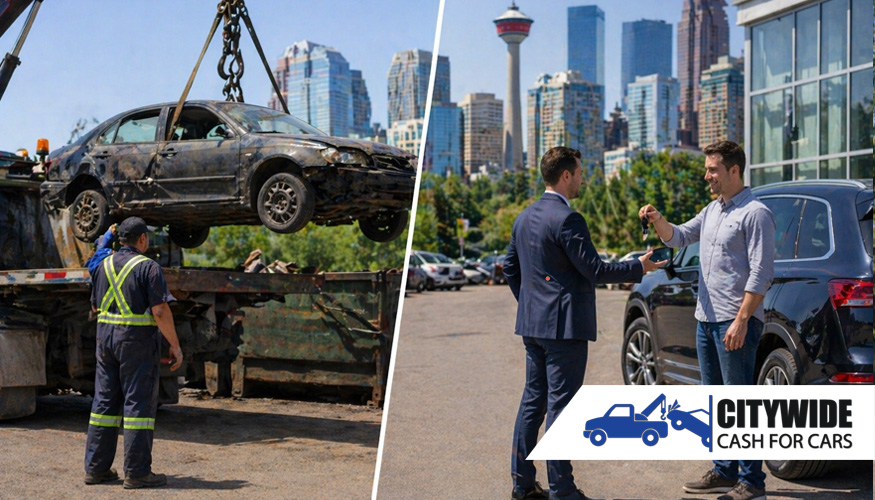
Why Scrapping Your Car in Calgary Is Better Than Trading It In
Let me tell you about a mistake I almost made.
A few years back I had a 2009 Honda Civic that had seen better days. The air conditioning had stopped working two summers ago, there was a persistent rattling noise coming from somewhere under the hood that three different mechanics had failed to diagnose, and the check engine light had been on so long I'd genuinely started to think of it as a design feature.
I figured I'd trade it in when I got my next car. Easy, right? Just drive it to the dealership, let them take it off my hands, and knock a bit off the price of the new one.
So I did. And they offered me $800.
Eight hundred dollars. For a car I'd been mentally valuing at somewhere around $3,000 because that's what similar ones were going for on Kijiji. The sales guy explained very calmly that given the condition, the mileage, and the current market, $800 was actually a generous offer.
I took it because I didn't know any better. A few weeks later a friend told me he'd scrapped a car in worse condition than mine and walked away with more money than I got at that dealership.
That was the last time I traded in a car without doing my homework first.
Dealerships Are Not on Your Side — And That's Fine, But Know It
Here's the thing about trading in a car. Dealerships aren't charities. They're businesses. And when they look at your old vehicle, they're not thinking about what it's worth to you or what you paid for it or how many road trips it survived. They're thinking about what it's going to cost them to recondition it, how long it'll sit on their lot, and what margin they can make when they sell it.
That calculation almost never works in your favour — especially if your car is older, high mileage, or has any mechanical issues at all. Because a dealership needs to profit twice — once when they buy your trade-in cheap, and once when they sell it. That squeeze comes straight out of your pocket.
And here's the part that really stings. A lot of people think they're getting a good deal because the dealership is "giving them" $1,500 off the new car for the trade-in. But that $1,500 credit often just gets baked into the financing, the interest rate, or the final purchase price in a way that's hard to see unless you know exactly what to look for.
Scrapping completely sidesteps all of that. You get a straight cash offer for your vehicle with no games, no negotiation theatre, and no waiting to see what they "can do for you."
What Your Old Car Is Actually Worth as Scrap
This is where a lot of people are genuinely surprised. They assume a car that doesn't run well or has visible damage is basically worthless. But scrap value doesn't come from how pretty the car is or whether it passes inspection. It comes from what's inside it.
Steel, aluminum, copper wiring, catalytic converters, salvageable mechanical parts — all of these have real commodity value in Calgary's scrap market. The price fluctuates with the metals market, but here's a rough idea of what people are actually getting:
- Smaller sedans and hatchbacks typically fetch between $200 and $500
- Mid-size cars and crossovers usually land between $400 and $700
- Full-size trucks and SUVs can easily reach $800 to $1,500 or more
Compare that to what a dealership is going to offer you for a car with high mileage or any kind of issue, and scrapping starts to look a lot more attractive pretty quickly.
The Trade-In Process vs The Scrap Process — Honestly
Trading in a car at a dealership is a time commitment most people underestimate. You drive in, they inspect the car, they disappear to "talk to the manager," they come back with a number, you negotiate, they go back again, eventually you agree on something that feels like a compromise but is actually just their number with slightly better presentation. The whole process can eat up three or four hours of your day and leave you feeling vaguely like you lost something even if you can't quite articulate what.
Scrapping a car works nothing like that.
You call or fill out a form online, give them the basic details — make, model, year, condition — and they give you a quote in a few minutes. If you're happy with the number you book a pickup. They come to your address anywhere in Calgary, load the vehicle, and hand you cash on the spot. The whole visit typically takes about twenty minutes. There's no negotiating, no waiting rooms, no feeling like you're being played.
One is a whole afternoon. The other is a phone call and twenty minutes at your door.
When Trading In Actually Makes Sense
To be fair, there are situations where trading makes more sense than scrapping. If your car is relatively new, in good condition, low mileage, and a model that dealerships actually want on their lot — you might get a decent trade-in value that's genuinely competitive with scrap offers. Some people also prefer the simplicity of handling everything in one place, even if it means a slightly lower return.
But if your car is older, has mechanical problems, has been in an accident, has high mileage, or is simply a model that dealerships aren't excited about — you are almost certainly going to do better scrapping it than trading it in. The dealership needs to make money on your car. The scrap buyer just needs the metal.
One More Thing Worth Knowing
A lot of Calgary residents don't realise they can get rid of a car that doesn't run at all — one that couldn't be driven to a dealership even if they wanted to. Non-running vehicles, cars that have been sitting outside for years, vehicles with missing parts — all of these are fair game for scrap removal companies. They bring a tow truck. You don't need to do anything except be home when they arrive.
That's a category of car that a dealership won't even look at. For a scrap buyer it's just another job.
The Bottom Line
Trading in feels convenient because it's bundled into the car buying process. You're already there, it's easy, and the salesperson makes it feel like they're doing you a favour. But convenience and profit are not the same thing.
If your car is at the end of its road, scrapping it in Calgary is almost always going to put more money in your pocket, take less of your time, and involve a lot less of the psychological chess that comes with walking into a dealership.
Your old car has value. The question is just who you let capture it — you, or the dealership.
Frequently Asked Questions
Q: Can I scrap a car that I still owe money on in Calgary? This is more complicated than scrapping a car you fully own. If there's still a lien on the vehicle you'll generally need to settle that with your lender before the title can be transferred. Some scrap companies can walk you through this process but it's worth sorting out the financing situation first before you book a pickup.
Q: Is scrapping a car in Calgary environmentally responsible? Yes, actually more so than most people realize. Licensed scrap yards in Calgary are required to drain and dispose of fluids like oil, coolant, and brake fluid properly before the vehicle is crushed. Usable parts get salvaged and resold, reducing the need for new manufacturing. And the metal gets recycled back into the supply chain. Compared to a car sitting and slowly leaking into the ground on your property, scrapping it is genuinely the better environmental choice.
Q: How quickly can I get my car scrapped in Calgary? Most reputable junk car removal companies in Calgary offer same-day or next-day pickup depending on your location and schedule. If you call in the morning there's a good chance your car is gone before the end of the day. The quote itself usually takes less than five minutes over the phone.
Q: Do I need to cancel my insurance before scrapping my car? Yes and it's actually one of the things people forget to do. Once your car is removed you should contact your insurance provider and cancel the policy or transfer it to your new vehicle. Continuing to pay insurance on a car you no longer own is just wasted money. Call your insurer the same day the car is picked up.
Q: What if my car has personal items or aftermarket parts I want to keep? Always do a walkthrough of the car before the tow truck arrives. Remove any personal belongings, important documents, and any aftermarket parts you want to keep — custom rims, a stereo, a roof rack. Once the car leaves your property it's gone for good. Five minutes of checking before they arrive will save you from any regrets afterward.
