
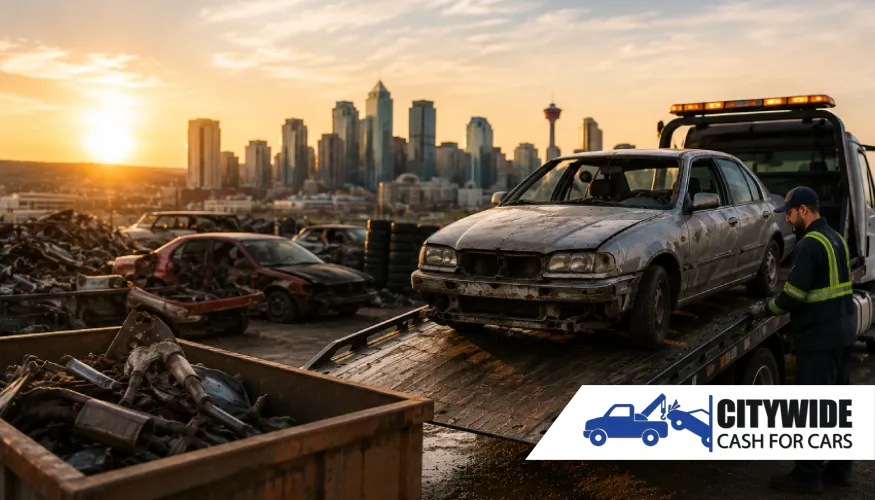
How to Cut Losses on Junk Vehicle Disposal in Alberta
Most people look at a dead car in the driveway and see a problem to pay someone to remove. That instinct is exactly what costs them money. A junk vehicle almost always has more value left in it than the first tow-truck quote lets on. The trick isn't luck. It's knowing where that value sits and being willing to spend an afternoon getting it out.
Here's how to walk away with more than pocket change.
The car is worth more than its scrap weight
When a scrapyard rattles off a number over the phone, they're usually pricing the steel. That's it. The body has a weight, steel has a market price that week, and the math spits out an offer. Fine as far as it goes, but it ignores everything else that's still bolted to the thing.
Think about what's actually under the hood. A working alternator. A starter that still turns. Wheels worth real money if the tires aren't bald. And the big one in Alberta right now, the catalytic converter, which can be worth more on its own than the entire scrap price depending on the vehicle. When you take a flat "cash for junk" offer, the buyer pockets all of that. You get the steel money and they get the rest. That's the loss, right there, and most people never notice it happening.
Never take the first offer
I can't stress this enough. Phone quotes on the same car swing by hundreds of dollars in this province, and the only way to find the high one is to make a few calls.
Give every buyer the same story: year, make, model, roughly the mileage, does it run, what's wrecked. Then ask the question that trips people up. Is towing included, or are they clawing it back out of the offer? A buyer who quotes you fifty bucks more but charges for pickup is the lower offer wearing a disguise. And if you're anywhere near Calgary or Edmonton, you've got leverage, because there are more recyclers fighting for the metal and shorter distances to haul it. Rural sellers usually see thinner numbers for that reason alone. Ten minutes of dialing beats every other tip on this page.
Scrap prices move, so timing helps
Steel is a commodity. Its price goes up and down like anything else traded, and recyclers set their offers off whatever the market's doing that week. Same car, different Tuesday, different money.
You don't need to trade metals futures. Just know that if the car's parked safely and it isn't bothering anyone, there's no law saying you have to dump it during a slump. Waiting for a firmer market can quietly add to your take. Weather plays in too. When Alberta winter really bites, towing gets miserable and offers soften to match. A clean, mild stretch often buys you a smoother pickup and a slightly better number.
Pull the good parts yourself, if you've got the time
This is where the money actually lives. Sold one at a time, the pieces beat the scrap value by a wide margin.
That catalytic converter is the headliner, thanks to the precious metals packed inside it. But the battery, the mirrors, the infotainment screen, decent body panels, the alternator I mentioned earlier, all of it has buyers on local marketplaces. Strip what's worth stripping, sell it off, then send the gutted shell for scrap. Now, be honest with yourself about time. Parting out a whole car is a project. If your evenings are already spoken for, just grab the two or three highest-value items and let the recycler take the carcass. Even that much moves the needle.
Don't fumble the paperwork
This is the part that turns a clean sale into a mess months later, and Alberta has a couple of specifics worth nailing down. Your plates stay with you. They belong to you, not the car, so peel them off before that flatbed pulls away.
Then cancel the registration and call your insurer. You want the coverage stopped and any unused premium refunded, and that money is easy to forget about. Write down who took the car, the date, and what they paid you, and hang onto a bill of sale or a disposal receipt. If that vehicle ever gets flagged, abandoned somewhere, or its VIN shows up where it shouldn't, that scrap of paper is what keeps the problem from becoming yours.
Pick a recycler who does it right
Cheapest and fastest isn't the same as smartest. A dead car is full of stuff you can't just let leak into the ground, coolant, oil, refrigerant, the odd mercury switch. Alberta has rules about handling all of it.
Going with a proper auto recycler who drains and disposes of everything correctly keeps your name clear of any illegal-dumping mess. It also tends to mean fairer pricing, because those outfits live on reputation instead of one-and-done cash grabs. Ask if they're established and insured, and ask where the car goes next. Funny enough, the responsible operators are often the same ones paying honest money.
The little leaks that add up
Beyond the headline price, there's a handful of small ways money slips out. Tow fees are the obvious one, already covered. Here are the others.
Don't let the car sit so long it earns you a bylaw complaint or storage grief. Never, ever hand it over before you've been paid. Clear out your belongings and any aftermarket gear first, because the second it's gone, it's gone for good. And if there's still fuel in the tank or a set of half-decent tires on it, those are chips to bargain with, not freebies to throw in. None of these are huge on their own. Together they're the difference between a fair deal and a great one.
Bottom line
Cutting your losses on a junk car in Alberta really comes down to one shift in thinking: stop treating the thing as garbage. Find the three places its value hides, shop your quotes around, sell the good parts separately, keep the paperwork tidy, and hand it to someone who'll dispose of it properly. Do that, and the write-off you were bracing to pay for turns into a modest payday instead. That's not luck. That's just refusing to leave money on the table.
