
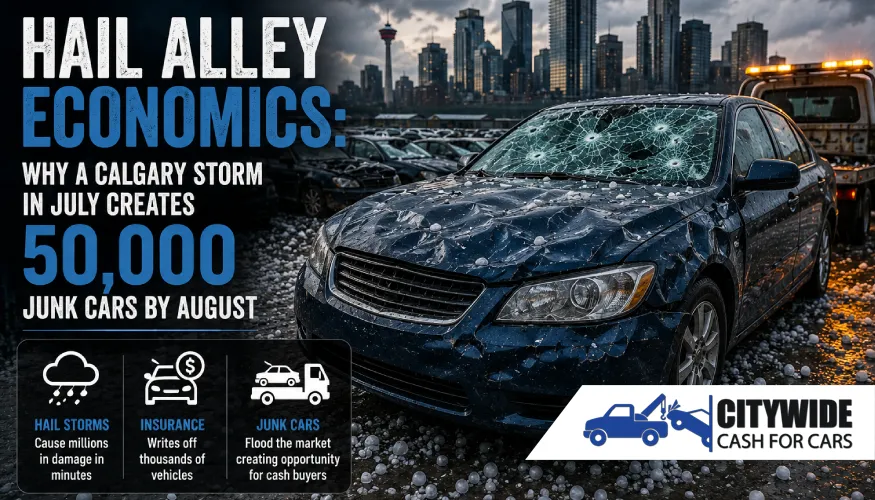
Hail Alley Economics: Why a Calgary Storm in July Creates 50,000 Junk Cars by August
There is a stretch of prairie running from Red Deer down through Calgary and out toward the Foothills that meteorologists, insurers, and tow truck operators all quietly refer to by the same name: Hail Alley. It is one of the most hail-prone corridors on the planet. And every summer, sometime between mid-June and early September, the sky over Calgary opens up, dumps ice the size of golf balls — sometimes baseballs — and quietly converts tens of thousands of perfectly drivable vehicles into junk cars within a matter of weeks.
This is not weather. It is economics. And once you understand how the math works, you understand why your driveway might host an insurance write-off long before you realize the car is dead.
The Insurance Math That Kills Cars
Here is what most Calgary drivers do not know. A car does not have to be undriveable to be declared a total loss. It only has to be uneconomical to repair.
Every insurer in Alberta — guided by Insurance Bureau of Canada standards — compares the cost of repairs against the vehicle's Actual Cash Value (ACV). When repair quotes climb past roughly 70–80% of the car's market value, the insurer writes it off. The driver gets a cheque. The vehicle gets a salvage title and a one-way ticket to an auto wrecker.
Now layer hail onto that formula.
A severe Calgary hailstorm does not break one panel. It dents the hood, roof, trunk, every door, both fenders, and often cracks the windshield and side glass. A modern auto body shop will quote $8,000 to $15,000 to make that car factory-new again — and considerably more on European vehicles. If your 2014 Corolla is worth $9,500 on the open market, the math is already over. The cheque is already being cut.
Multiply that across a single storm cell that crosses 80 kilometres of dense urban Calgary, and the August headline writes itself: tens of thousands of cars, all written off in the same two-week window.
Why "50,000" Is Not an Exaggeration
Calgary's August 2024 hailstorm produced more than $2.8 billion in insured damage, making it the costliest hail event in Canadian history. Auto claims alone numbered in the tens of thousands, and entire neighbourhoods — Saddle Ridge, Martindale, Taradale, Coral Springs, Falconridge — looked like an auto body shop had detonated overhead.
That is not a one-off. Calgary has now experienced multiple billion-dollar hail events in the past decade. Insurers have responded the same way each time: raise premiums, tighten deductibles, and write off marginal vehicles faster, because the cost of paint-and-body labour has outpaced what older cars are worth.
The result is a predictable late-summer surge. Tow yards fill up. Auto wreckers run out of storage. Scrap car removal companies in Calgary go from 5 calls a day to 50. And drivers — many of whom still owe money on their financed vehicle — find themselves holding a settlement cheque that does not cover the loan.
The Problem No One Warns You About
If your car is written off after a Calgary hailstorm, three things happen that most drivers do not see coming.
First, the payout reflects ACV, not what you owe. If you financed the vehicle with low money down, your settlement can leave you thousands short — a gap only GAP insurance covers, and most Calgarians do not carry it.
Second, a salvage title destroys resale value. Even if your car is technically repairable, accepting the buyback offer and rebranding it salvage cuts its future value by 40–60%.
Third, storage fees accumulate fast. Once an insurer takes possession, the clock starts. If you wait too long to decide between buyback and surrender, you can end up paying daily storage on a car you no longer want.
This is the trap. The hailstorm did not just damage your car. It triggered a financial decision that most owners are unprepared to make under time pressure.
The Smart Play for Calgary Drivers
Here is what to do the moment a major hail event hits your neighbourhood:
- Document everything in the first 24 hours. Photos of every panel, the windshield, the interior if water entered through cracked glass. Insurers settle faster on well-documented claims.
- Get an independent ACV estimate. Do not accept the first number. Canadian Black Book values and recent comparable listings on AutoTrader can justify a higher payout.
- Decide quickly between keep, buyback, or surrender. If the car is older than 10 years, the buyback is almost never worth it. The economics favour taking the cheque and selling the shell to a Calgary scrap car removal service or auto wrecker for additional cash.
- Stack the cheques. Insurance payout + scrap value + catalytic converter value (often $100–$400 on its own) can exceed what you would have gotten trying to sell the damaged car privately — with none of the Kijiji headaches.
For a hail-totalled 2010 Civic in Calgary, that stack often looks like this: $4,500 insurance settlement + $350 scrap value + $250 catalytic converter = $5,100 in your account inside a week.
Why August Is the Best — and Worst — Time to Scrap
Scrap metal prices fluctuate, but the bigger factor is supply. After a major Calgary hailstorm, wrecker yards are flooded with inventory and quotes drop. Drivers who wait two or three weeks after the surge often see noticeably better offers, because yards have processed inventory and reopened storage.
If you are not in a rush, patience pays. If you need the car gone yesterday because the insurer is charging storage, take the first reputable cash offer and move on. The wrong move is the middle ground — waiting just long enough to accumulate storage fees without waiting long enough for prices to recover.
The Bottom Line
Calgary's geography makes hail unavoidable. The insurance industry's math makes write-offs inevitable. And the two together produce a predictable August flood of junk cars that most drivers walk into completely unprepared.
The driveway-to-wrecker pipeline is real. Knowing how it works is the difference between a payout that covers your loan and one that leaves you stuck — and between a scrap quote that feels insulting and one that adds a meaningful cheque to a bad week.
Hail Alley is not going anywhere. The Calgary drivers who understand the economics of it will always come out ahead of the ones who do not.
