
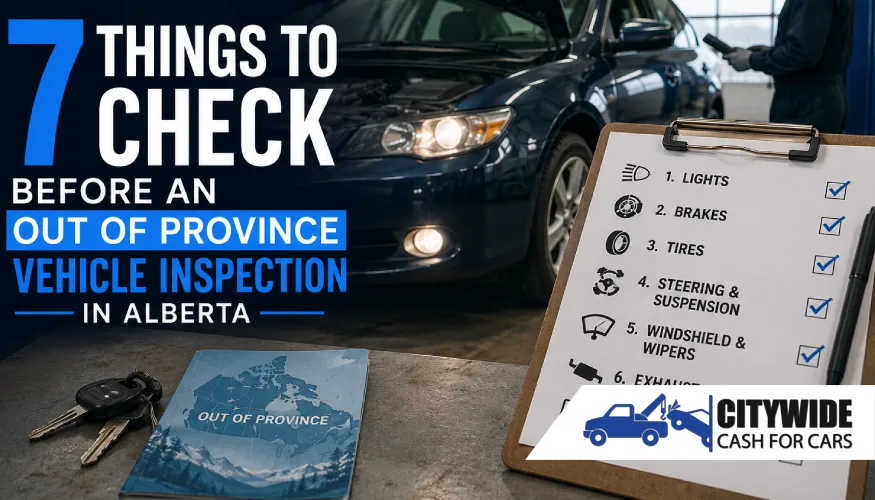
7 Things to Check Before an Out of Province Inspection
So you just moved to Alberta — or you're buying a vehicle from another province — and someone mentioned you need an "out of province inspection." Maybe you nodded like you knew what that meant. Maybe you didn't. Either way, you're here now, and this article is going to make sure you walk into that inspection fully prepared, not caught off guard with a repair bill you weren't expecting.
Let's get into it.
What Is an Out of Province Vehicle Inspection, Anyway?
Before the checklist, a quick 60-second explainer.
In Alberta, any vehicle that was previously registered in another Canadian province or territory — or imported from the United States — must pass an Out of Province (OOP) Vehicle Inspection before it can be registered locally. This applies whether you're bringing your own car after a move or purchasing a used vehicle that was titled elsewhere.
The inspection is done by an Alberta-licensed inspection facility — not just any mechanic. It's a safety check to make sure the vehicle meets Alberta's road standards. It's not optional. It's not something you can skip. And it's not as scary as it sounds — if you know what to check before you go.
That's where this list comes in.
1. Check Your Lights — All of Them
This one sounds almost too simple, but it's one of the most common reasons vehicles fail their first inspection attempt.
Walk around your car at night — or in a dim garage — and check every single light:
- Headlights (low beam and high beam)
- Tail lights
- Brake lights (get someone to help, or lean something against the pedal)
- Reverse lights
- Turn signals — front and rear, both sides
- Hazard lights
- License plate light
- Fog lights (if equipped)
One burnt bulb can fail the inspection. The fix costs $5 and ten minutes. The failed inspection costs you rebooking fees and wasted time. Check the lights.
2. Look at Your Tires — Honestly Look
Tires are another big one. Alberta inspectors check for tread depth, sidewall condition, and whether all four tires match appropriately.
Here's what to look for:
Tread depth: Alberta requires a minimum tread depth of 1.6mm (the wear indicators built into the tire grooves). If you're unsure, the penny test works — insert a penny into the tread groove with the Queen's crown facing down. If the crown is fully visible, your tires are too worn.
Sidewall damage: Bulges, cuts, or cracks on the sidewall are automatic failures. Run your hand along the sidewall and look for anything that seems "off." A bulge especially is not just an inspection problem — it's a blowout waiting to happen.
Mismatched tires: Having radials mixed with non-radials, or dramatically different sizes on the same axle, can flag an issue. Make sure your tires are consistent at least across each axle.
If your tires are borderline, replace them before the inspection. You'll need them soon anyway.
3. Test Your Brakes Before Someone Else Does
Brakes are a core part of the OOP inspection — and for good reason. Inspectors will check brake pad thickness, rotor condition, and brake line integrity.
Before your appointment, pay attention to:
- Squealing or squeaking when you apply the brakes — usually worn pads
- Grinding sounds — metal on metal, meaning the pads are gone
- Vibration or pulsing in the pedal — warped rotors
- Pulling to one side when braking — uneven brake wear or a stuck caliper
- Soft or spongy pedal — could indicate air in the brake lines or a fluid issue
If anything feels "off" when you brake, get it looked at before the inspection. A brake job is expensive, yes — but it's something you'll need regardless of the inspection. Better to do it on your timeline than scramble after a failed report.
Also check your parking brake. It should hold the vehicle on a slope without issue. Inspectors will test it.
4. Check for Rust — Especially Underneath
This one matters more than most people realize, and it's often a surprise fail for vehicles coming from wet or coastal provinces.
Alberta inspectors pay close attention to structural rust — not surface rust on the body panels, but rust that affects the frame, subframe, control arms, or any structural component.
Here's what to do: get under the car (use a flashlight) and look at:
- The frame rails running front to back
- Suspension components — control arms, trailing arms, struts
- Brake lines — rust here is dangerous and a common fail point
- Floor pans — visible from underneath, rust-through is a red flag
- Exhaust system — inspectors check that it's not rotted through and leaking
Surface rust on non-structural components won't necessarily fail you, but flaking, pitted, or penetrating rust on anything structural absolutely will. If you're unsure, a pre-inspection at a trusted mechanic before the official appointment can save you a lot of stress.
5. Make Sure Your Windshield and Glass Are in Good Shape
A cracked windshield is a frequent and avoidable fail. Alberta has specific rules about what's acceptable:
- Any crack in the driver's direct line of sight (roughly a 30cm zone in front of the driver) is a failure
- Chips or cracks that could spread under temperature changes may also be flagged
- Tinted windows must meet Alberta's legal tint limits — rear and side windows have some flexibility, but the front windshield must have high visible light transmission
If you have a chip, get it repaired before the inspection. Chip repairs cost $50–$100 and take an hour. A full windshield replacement — if the crack is too large to repair — will run $300–$600+. Address it early.
Also check your windshield wipers. They need to be cleared effectively. Streaky, chattering, or shredding blades are a quick and cheap fix — and inspectors do check them.
6. Verify Your VIN and Documentation Is Ready
This is less mechanical but just as important. Before your inspection appointment, gather:
- The vehicle's current registration from its home province or state
- Proof of ownership (title or bill of sale if recently purchased)
- Your Alberta address (you'll need it for the registration process after)
- The VIN — make sure it's visible and legible on the dashboard and door jamb, and that it matches your documents
Inspectors will verify the VIN physically matches the paperwork. If you're buying a used vehicle from another province, run a CARFAX or CarProof report before anything else. You want to confirm the vehicle hasn't been written off, salvaged, or had its odometer rolled back. A clean history report also speeds up the post-inspection registration process significantly.
If the VIN plate is damaged, tampered with, or missing — that's a serious problem that goes beyond inspection. Resolve that first.
7. Check Your Fluid Levels and Under the Hood Basics
Inspectors won't necessarily fail you for low washer fluid — but they will check the overall mechanical condition of the engine bay, and some fluid-related issues absolutely can fail you.
Before your inspection, check:
- Engine oil — level and condition (dark, gritty oil isn't a fail, but a leak dripping onto the exhaust or onto the ground is)
- Coolant — should be between the MIN and MAX marks on the reservoir
- Brake fluid — low brake fluid can signal a leak or worn pads
- Power steering fluid (if applicable)
- Windshield washer fluid — not a fail, but inspectors notice
- Battery terminals — corroded terminals are flagged; clean them with a wire brush and baking soda solution
Also look for any obvious fluid leaks under the car after it's been parked overnight. An oil stain, coolant puddle, or power steering drip on your driveway is a sign something needs attention before inspection day.
And if your check engine light is on — that's a problem. Inspectors may note active diagnostic trouble codes, and some will flag it on the report. Get the code read (most auto parts stores do this for free) and understand what you're dealing with before you show up.
Bonus: Book With a Certified Inspection Facility
One thing people often miss — you can't just walk into any shop. The inspection must be performed by an Alberta-approved inspection facility. These are licensed by Alberta Transportation and will have the authorization displayed.
Call ahead, book an appointment, and ask what documentation to bring. A five-minute phone call can save you a wasted trip.
The Bottom Line
An out of province vehicle inspection in Alberta isn't something to fear — it's just a process. And like most processes, the people who prepare for it come out the other side smoothly, while the people who wing it end up paying for re-inspections and last-minute repairs.
Go through this list. Be honest with yourself about what needs attention. Fix the small stuff before inspection day. And if you're buying a vehicle from out of province, factor potential inspection costs into your negotiating price — because what looks like a deal can get expensive fast if the car needs $2,000 in work to pass.
You've got this. Now go check those tail lights.
